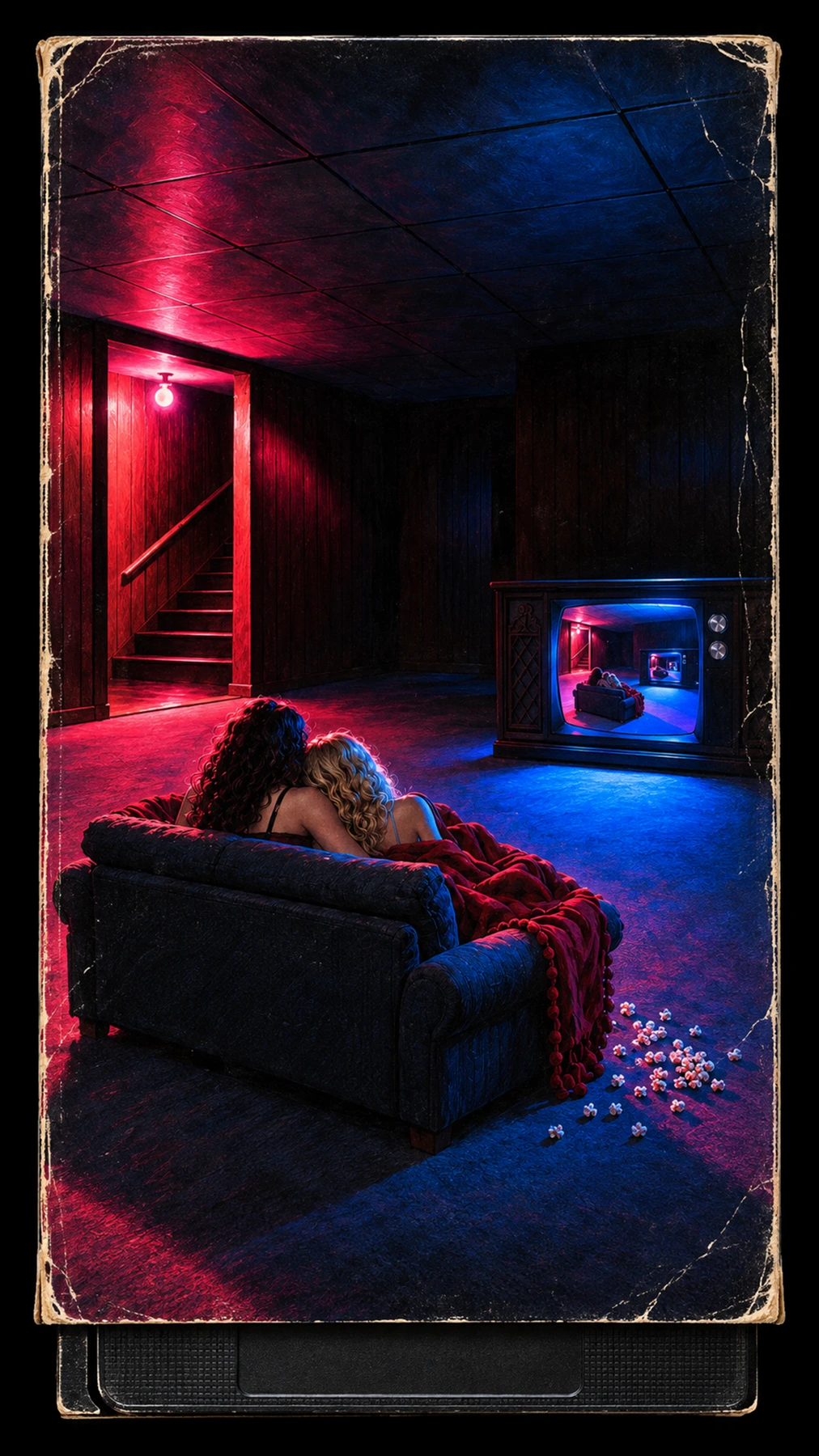
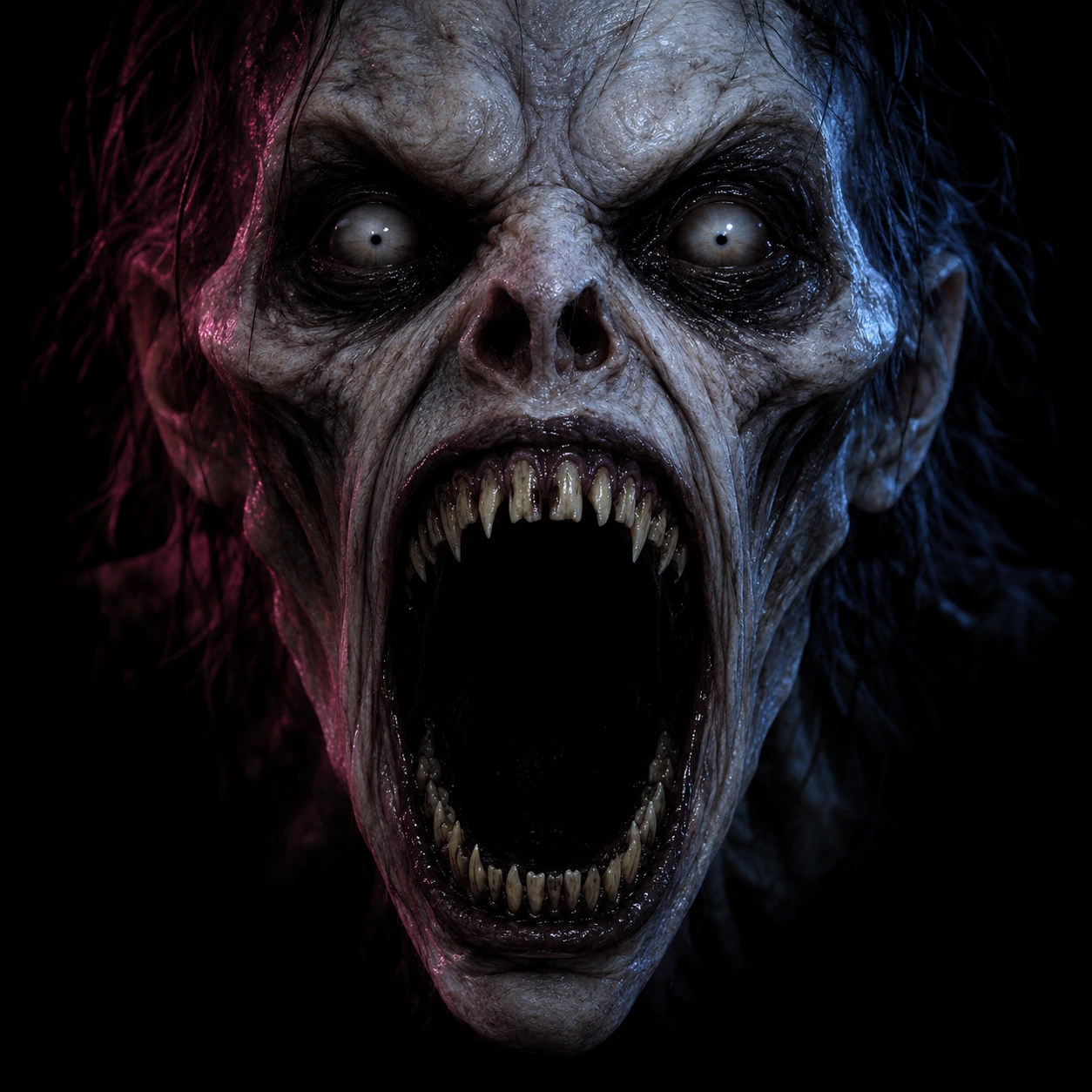
By the time two apparent lovers begin calling a house in Amityville ours, somebody really ought to have contacted a realtor, a priest, or the police. The encounter that brought them together has supplied plenty of material for theories involving murder, haunting, and exceptionally poor judgment, but it has also supplied something suspiciously like a happy ending. Whether anybody involved is alive remains an open question.
Horror traditionally rewards its Final Girl for escaping the house, preferably after disposing of whoever or whatever was living there. These two appear to have found the place rather charming. Whatever's wrong with that house, the new occupants seem well suited to the neighborhood.
Everybody knows the rules by now. Don't investigate strange noises, don't split up, never announce you'll be right back, and, for God's sake, don't have sex. That last one is particularly unfortunate, considering how much of the genre seems determined to encourage it. Randy Meeks's survival lecture in Scream gave audiences a wonderfully concise vocabulary for conventions they'd been recognizing, arguing about, and shouting at the screen for decades. He survived one massacre and died in the sequel, which rather undermines his credentials as a survival instructor.
The newer Scream films have updated the commandments for an audience that knows the tricks, knows the filmmakers know the tricks, and has probably already posted a theory about the next Ghostface. But familiarity with the rules doesn't make them any more reliable, and recognizing a convention isn't necessarily the same as understanding why it exists. [1]
Carol J. Clover's account of the Final Girl in Men, Women, and Chain Saws was considerably subtler than the popular instruction that virgins survive while sexually adventurous women die. Clover showed how horror could shift a spectator's identification toward the woman confronting the killer, complicating easy assumptions about gender and the pleasure of watching somebody fight for their life.
Yet the genre's traditional survival bargain has often rewarded a fairly narrow conception of acceptable femininity: innocent without being boring, desirable without desiring too much, and—in much of mainstream American horror—white, presumed cisgender, and heterosexual. Exceptions abound, as they should, but convention has a peculiar habit of masquerading as moral law. The Final Girl doesn't merely have to survive the monster; she has to satisfy somebody's idea of what sort of woman is worth saving. [2]
And there's the awkward business of what we're invited to enjoy while she's trying. Horror has produced a practically inexhaustible supply of films in which women are watched, chased, possessed, exposed, penetrated, or dismembered, sometimes as legitimate inquiry and sometimes as violence wearing a remarkably flimsy plot. Psycho is a masterpiece of implicating the spectator in voyeurism, yet Norman's identification with Mother also helped establish a cinematic shorthand associating unconventional femininity with murderous pathology.
Norman isn't a transgender woman, nor is Buffalo Bill in The Silence of the Lambs straightforwardly presented as one; Leatherface's masks and domestic performances in The Texas Chain Saw Massacre serve yet another set of narrative purposes. These films aren't interchangeable, and their considerable achievements deserve more than a retrospective conviction for crimes against modern sensibilities. Still, it's worth noticing how often horror finds femininity so desirable that a man might stalk, possess, or destroy it, yet so disturbing when expressed outside his expectations that it becomes part of what makes the psychopath frightening. The problem isn't femininity. It's the gaze that has historically enjoyed the authority to decide where femininity belongs. [3]
Which makes Room 237 in The Shining a particularly fascinating place to visit, though one wouldn't necessarily recommend staying the night. Jack Torrance embraces a beautiful young woman, only to discover that she's an elderly, decomposing apparition. Her continued pursuit after he recoils is genuinely threatening, and the decay is certainly unpleasant, but the visual journey from erotic pleasure to absolute revulsion passes directly through a woman growing old. Kubrick may be exposing the ugliness of Jack's gaze as much as inviting the audience to share it; the ambiguity is part of what makes the sequence interesting.
Nevertheless, the transformation is so familiar a cinematic equation that the additional decomposition almost feels like insurance against anyone questioning it. Coralie Fargeat's The Substance takes that same bathroom mirror and turns it inward. Elisabeth Sparkle has absorbed the judgment so completely that she no longer needs Jack Torrance to recoil from her aging body. She's perfectly capable of doing it herself.
Fargeat then spends the remainder of the film pushing that logic toward an increasingly outrageous conclusion, culminating in a finale that feels like a blood baptismal for an audience that has spent the evening deciding what a woman's body is worth. The connection to Carrie is glorious: where Carrie is publicly humiliated by a shower of blood, Monstro Elisasue returns the favor on a truly industrial scale. Nobody gets to remain a clean, innocent spectator, including the people watching the movie. [4]
In Revenge, Fargeat approaches the same entitlement from the opposite direction, insisting that her protagonist's sexual confidence was never permission for the men who believed they owned her. Teeth makes the argument considerably more anatomical, taking the ancient male nightmare of the vagina dentata and turning it into a painful, complicated response to sexual coercion. There's a great deal of cinematic history between these women and the bodily anxieties of Rosemary's Baby, The Exorcist, and Carrie, but the underlying question remains remarkably consistent: why should a woman's capacity to refuse, retaliate, age, or simply exist outside somebody else's expectations be more frightening than the violence directed against her? [5]
That question becomes even more interesting when we stop pretending there's a single universal experience of womanhood waiting to replace the old gaze. In Nikyatu Jusu's Nanny, the wealthy American home is a very different kind of haunted house for the Senegalese immigrant employed to care for somebody else's child while separated from her own. Good Manners entwines race, class, motherhood, and desire in the relationship between a Black caregiver and her wealthy white employer, while The Blackening takes the familiar rule that Black characters die first and poses an almost embarrassingly obvious question: what happens when everyone in the horror movie is Black?
The resulting comedy works because the convention was never quite as universal as its audience had been encouraged to assume. These films aren't merely changing who appears on screen. They're changing whose fears get to organize the story, and whose experiences have been missing from the supposedly universal rules all along. [6]
Jennifer's Body was practically made for this conversation, although its original marketing department appears to have missed the invitation. Karyn Kusama and Diablo Cody produced a film about female friendship, exploitation, consumption, and an appetite that refuses to remain conveniently metaphorical; the promotional campaign seemed considerably more interested in selling Megan Fox to teenage boys. Queer audiences have since found enormous pleasure in the film's refusal to sort desire, identification, jealousy, and violence into tidy little compartments. This doesn't make Jennifer a role model or settle the precise nature of her relationship with Needy. She's frequently awful, which is rather the point.
Anna Biller's The Love Witch likewise refuses the assumption that feminine beauty must exist exclusively for a masculine spectator, while Rose Glass's Love Lies Bleeding gives us a gloriously physical queer romance in which affection, transformation, obsession, and extraordinarily bad decisions are permitted to occupy the same relationship. These characters don't become morally superior by virtue of their queerness. They get to be as complicated, selfish, passionate, and potentially catastrophic as the heterosexual lovers who've been ruining one another's lives on screen for the better part of a century. Equality has its privileges. [7]
None of this requires the monster to become innocent, or every outsider to be revealed as a queer allegory. The Babadook's improbable second career as a gay icon shows how readily an audience can reclaim an image without changing its original biography. The chant of belonging in Freaks can resonate far beyond its original context while the film's own relationship with disability and spectacle remains complicated.
Jane Schoenbrun's I Saw the TV Glow goes somewhere more intimate, exploring how fictional worlds can furnish the language of a self someone hasn't yet been able to recognize or inhabit. For queer and transgender spectators, the experience of seeing something familiar in an ostensibly unfamiliar character can be profoundly meaningful, but that recognition doesn't require assigning the character a definitive identity. Sometimes a reading tells us as much about the possibilities available to the person watching as it does about the person on screen. [8]
This is where critical theory and fan theory start looking like relatives who have been arguing at the same Thanksgiving table for twenty years. Both notice patterns, borrow interpretive frameworks, and discover possible meanings that aren't necessarily announced in the dialogue. Both can enrich a story, and both can become spectacularly overconfident about what they've discovered.
The internet has made it possible to turn a passing suspicion about a background detail into an elaborate explanation of an entire fictional universe, complete with supporting screenshots, competing factions, and a small army of people insisting the answer was obvious all along. A culture raised on Scream's self-awareness is remarkably good at knowing the trick before it's performed, then explaining the explanation before anybody asks. But recognizing a pattern isn't proof of intention, and doubt doesn't become certainty just because a theory has accumulated a convincing edit and several thousand followers.
Eve Kosofsky Sedgwick's concept of reparative reading offers a useful alternative to criticism that only knows how to expose: a flawed cultural object can still offer pleasure, recognition, and opportunities for imaginative reuse without requiring us to excuse its problems. [9]
There is something wonderfully post-ironic about the resulting relationship with horror. We know the conventions, recognize the manipulations, and can often anticipate the punchline, but we still want to be frightened, moved, or surprised. Knowing that a movie is trying to make us cry doesn't necessarily prevent the tears, just as knowing every possible romantic red flag doesn't make somebody immune to falling in love.
Sometimes the knowingness itself becomes a kind of emotional armor: if you can identify the trope, make the joke, and announce the probable disaster before anyone else does, perhaps nobody will notice how much you actually care. The trick is that the feelings remain perfectly capable of finding you anyway. Horror has always been unusually good at exploiting that vulnerability, even when its audience is convinced it has seen everything.
It's an especially fruitful genre for the romantically suspicious because desire already speaks fluent monster. You can be haunted, possessed, left breathless, or ghosted; a body count is either a criminal investigation or an intimate disclosure. The Ring makes waiting for a telephone call a matter of life and death, while The Sixth Sense offers a revelation about seeing dead people that could serve as either a supernatural confession or an exceptionally peculiar pickup line. Misery makes devotion indistinguishable from captivity, and The Blair Witch Project understands how frightening it can be not to know what happens when you close your eyes.
Even the whispered menace of Friday the 13th can become a private language of intimacy and threat, though the spectacularly excessive violence of Riki-Oh reminds us that not every man punching through another man needs an accompanying dissertation. Sometimes cinema is simply cinema, and thank goodness for that. [10]
In JUMP SCARE!, the familiar language of a VHS horror marathon becomes a way for two people to test how much the other knows, wants, or might be concealing. Freddy Krueger's nursery rhyme sounds suspiciously like an invitation, a compliment wanders into Leatherface's troubling relationship with cosmetics, and even an argument about the EPA in Ghostbusters becomes evidence of possible romantic compatibility. For the record, Walter Peck may have had a legitimate concern about a privately operated paranormal containment facility in the middle of Manhattan, but he remains a narc.
The pleasure of recognizing these references is inseparable from the uncertainty of what they're doing there. Are they clues, confessions, flirtations, or spectacularly elaborate dirty jokes? When both participants reach for knives, the usual distinction between threatened and threatening becomes rather unhelpful; when a knife subsequently ends up beside the snacks, the gesture might indicate trust, or simply a commendable commitment to hospitality.
Vampires, at least, have traditionally observed one useful boundary: they need an invitation to enter. Let the Right One In makes that threshold as emotionally consequential as it is supernatural, while Dracula's appreciation of the music of the night's creatures reminds us that terror and pleasure can depend upon who's listening.
An invitation doesn't guarantee safety, and it certainly doesn't excuse whatever the guest might do after crossing the threshold, but it complicates the old assumption that the monster must always arrive unwanted. What if the person inside knows perfectly well what's standing at the door? What if they're curious? What if they're dangerous, too? A great deal of horror depends on restoring the boundary between the safe and the monstrous, but a great deal of intimacy depends upon deciding that another person is worth inviting into one's life despite the impossibility of knowing everything about them.
Which brings us back to that house in Amityville, and the curious collection of unanswered questions surrounding its apparent new occupants. Did somebody kill somebody? Are they ghosts, vampires, lovers, or something that hasn't yet occurred to us? Is Mother upstairs, and if so, whose mother? Does anyone actually own this property? Is the opening scene a Shining homage suggesting that they've been here before, or is it simply one more affectionate nod to a movie they both happen to know?
The possibilities are entertaining, and some are more persuasive than others, but the story doesn't oblige us to settle upon a single explanation. Nor does interpreting the encounter through a sapphic or transgender lens require us to establish either character's identity as a supernatural revelation. That would merely reintroduce one of horror's oldest and least interesting habits under the guise of having outgrown it.
What makes the ending work is that the apparent romance and the possible nightmare no longer require separate conclusions. Two people who may have every reason to fear each other seem to have discovered a mutual attraction, and the conventional instruction to escape the monster has been replaced by the considerably more alarming prospect of sharing a home with one.
For a dating culture fluent in red flags, situationships, attachment styles, ghosting, and the strategic avoidance of emotional vulnerability, there's something almost admirably reckless about deciding to stay. Perhaps it's a romantic triumph; perhaps everyone else in Amityville should start making alternative arrangements. Both possibilities can be true, and neither requires the audience to decide who deserves to be saved before enjoying the story.
The Final Girl was supposed to escape the house, defeat the killer, and leave whatever happened inside firmly behind her. She was never promised that the monster might share her taste in movies, understand her terrible jokes, or turn out to be somebody she'd rather go home with. The old rules don't offer much guidance for that situation, perhaps because they were never particularly interested in what their survivors might want after the credits.
Knowing those rules is still great fun, especially when you can find someone who knows them just as well. But there's something even more interesting about discovering which ones were never really about survival in the first place.
The scariest thing about this ending isn't that they might be monsters. It's that they might be perfect for each other.